
In this article:
- Opening Answer
- Pros vs DIY Filing
- When DIY Works — and When It Doesn’t
- Fee Structures Explained
- What to Look for in a Consultant
- Red Flags to Avoid
- The Real Benefits of Hiring the Right Consultant
- FAQ
- Next Step
Opening Answer
If your business is planning to claim SR&ED, hiring the right consultant can materially improve both the size and defensibility of your claim. For many Canadian companies, the issue is not whether they did eligible work, but whether they can identify it properly, document it to CRA standards, and avoid leaving money unclaimed.
A realistic example: a mid-sized software company spending $450,000 on eligible salaries, contractor costs, and related SR&ED work could recover a meaningful portion of those costs through the program. But if the claim is framed as routine development rather than work involving technological uncertainty, the same project can be underclaimed, challenged, or rejected. That gap is where a capable SR&ED consultant often earns their keep.
Should I Hire an SR&ED Consultant?
The question behind “should I hire SR&ED consultant” is usually not just about convenience. It is about risk, claim size, internal bandwidth, and whether your team knows how to translate technical work into a CRA-ready filing.
For some businesses, DIY filing is workable. For others, it creates expensive blind spots. The right choice depends on the complexity of your work, the quality of your documentation, and how confident you are in applying CRA SR&ED criteria to real projects rather than generic examples.

Pros vs DIY Filing
A business can absolutely file SR&ED without outside support. Some finance teams and technical leaders know the program well, have solid project records, and can connect their work to the CRA’s requirements around technological uncertainty, systematic investigation, and technological advancement. In a narrow set of cases, DIY is reasonable.
But many claims break down in practice for predictable reasons.
Project identification
Internal teams often assume SR&ED is limited to major inventions, patentable technology, or formal R&D departments. In reality, many qualifying claims come from operational development work where teams are trying to resolve technical barriers that standard practice could not solve. We regularly see eligible work overlooked in software, manufacturing, engineering, food processing, and custom product development.
Narrative quality
CRA does not approve claims because a company spent money on technical work. It assesses whether the work meets the program’s criteria. That means your filing has to explain what uncertainty existed, why competent professionals could not readily resolve it using standard methods, what systematic work was performed, and what advancement was sought. That is where weak DIY claims often fail.
Time
Good SR&ED claims require coordination between finance and technical staff, collection of support, and disciplined drafting. For leadership teams already managing delivery, hiring, and cash flow, SR&ED becomes a rushed year-end exercise. That tends to produce vague project descriptions, missing support, and conservative claims.
Where a consultant adds value
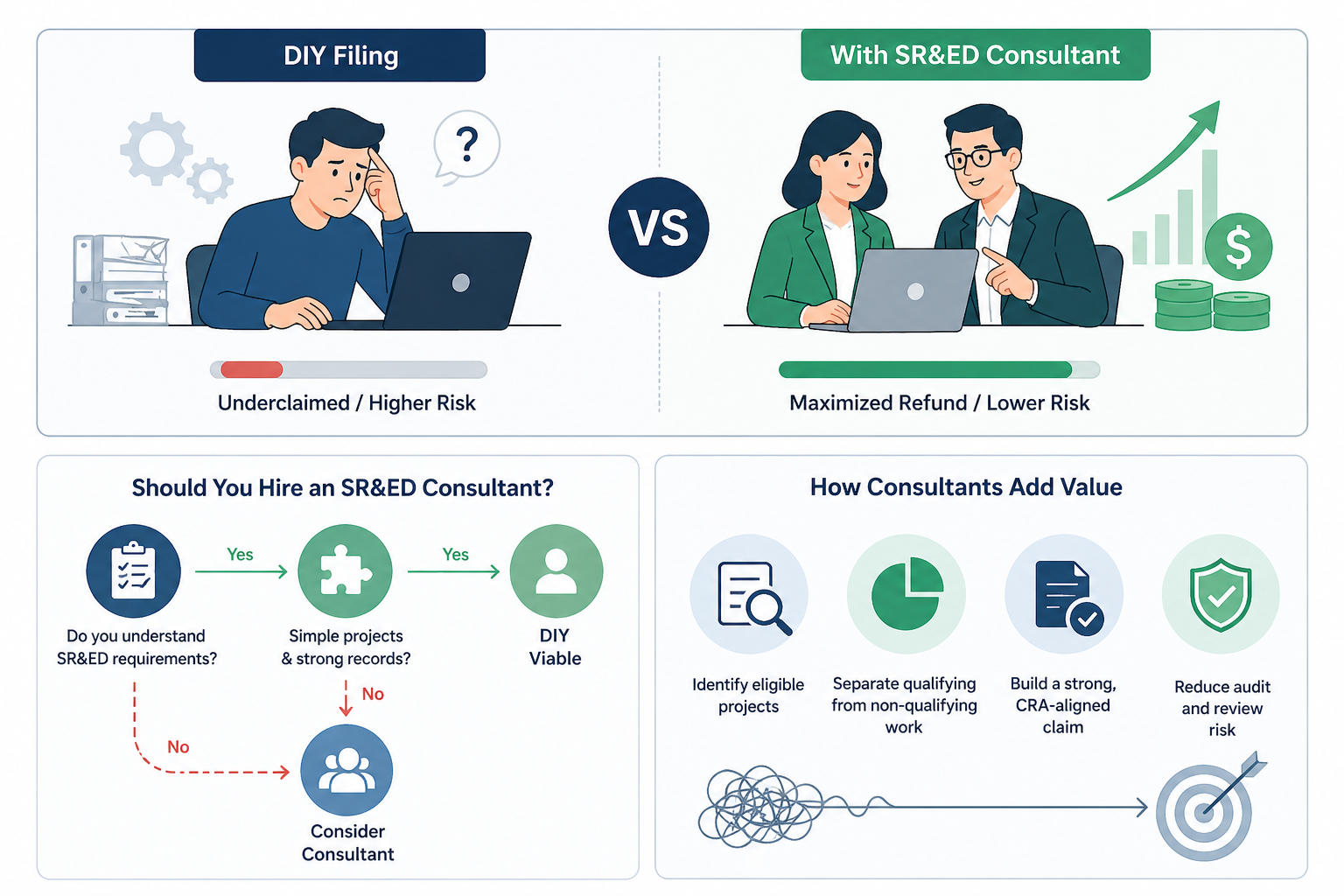
A consultant can add value in four ways:
- identifying projects your team may miss
- separating qualifying work from non-qualifying work
- building a claim around CRA language and expectations
- reducing audit and review risk through stronger support
That does not mean every consultant is worth hiring. It means DIY should be compared against the real cost of underclaiming, rework, and avoidable CRA challenges.
Consider a manufacturer that spent $900,000 trying to improve line consistency for a difficult material with unstable thermal behaviour. Internally, management described the work as “process optimization.” A consultant may recognize that the real issue was repeated experimentation to resolve a technological uncertainty in production behaviour under variable conditions. That difference in framing can determine whether the project is just operational improvement or an eligible SR&ED claim.
When DIY Works
DIY is usually most defensible when the business has:
- one or two straightforward projects
- strong contemporaneous technical records
- experienced finance leadership
- internal staff who understand SR&ED eligibility Canada requirements
- time to prepare clear technical narratives and cost allocations
Even then, the business should be realistic. Filing yourself is not the same as filing well.
When hiring a consultant is usually the better move
External support is often worth serious consideration when:
- your team is claiming for the first time
- your projects involve nuanced software, engineering, manufacturing, or scientific work
- your documentation is incomplete and needs reconstruction
- prior claims were denied, reduced, or heavily reviewed
- your internal team is unsure what actually qualifies
- you suspect there may be overlooked projects across departments
This is especially true for companies doing technically difficult work that does not look like “traditional R&D” on the surface.
For example, a SaaS company working to reduce API response times under high concurrency may believe it was simply improving performance. But where standard architecture patterns and known optimization methods failed, and the team had to test competing approaches around queue management, database contention, and caching behaviour to achieve a technological advancement, part of that work may qualify. The same project, written lazily, might sound non-eligible. Written properly, it may align with CRA criteria.
Another common case is in manufacturing. A company may be trying to reduce defect rates on a new material input. If the issue can be solved with ordinary calibration or supplier adjustment, that is generally not SR&ED. But if the team faces an unresolved technical problem and runs structured trials to understand process-variable interactions that are not readily deducible by a competent professional, the work may cross into eligible SR&ED territory.
That contrast matters. Good consultants help define the line.
For businesses comparing options, it helps to review what professional support actually covers on a dedicated SR&ED Consulting Services page rather than assuming all firms do the same work.
Fee Structures Explained
One of the biggest reasons businesses hesitate is cost. That is fair. But fee structure matters more than headline price. For a deeper breakdown of typical pricing ranges by engagement model, see our guide on how much an SR&ED consultant costs in Canada.
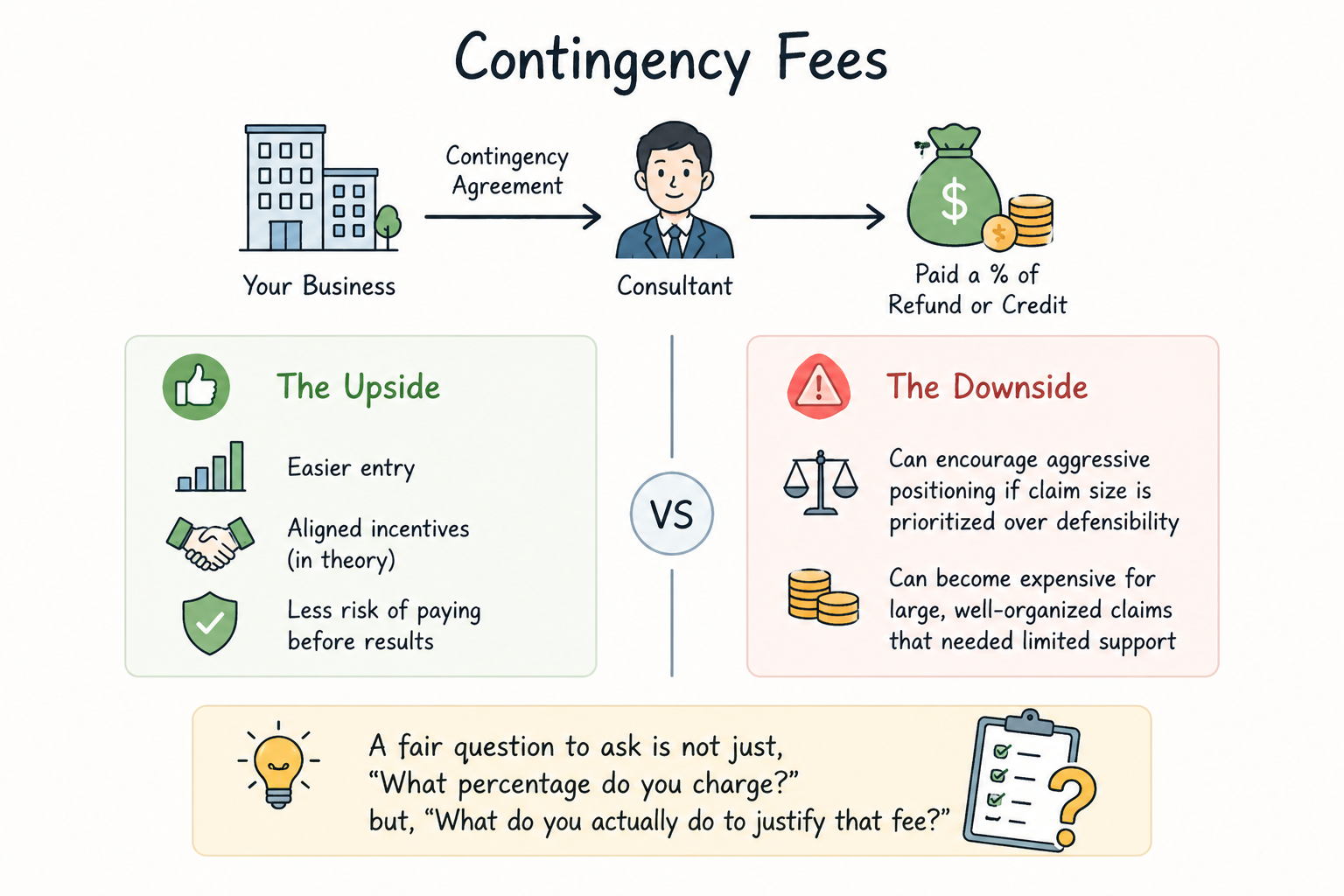
Contingency fees
Under a contingency model, the consultant is paid a percentage of the refund or credit. This appeals to businesses that want lower upfront cost and less cash-flow pressure.
The upside is obvious: easier entry, aligned incentives, and less risk of paying a large fee before a claim is successful.
The downside is that not all contingency models are equally aligned. A percentage-based fee can encourage aggressive positioning if the consultant prioritizes claim size over defensibility. It can also become expensive for companies with large, well-organized claims that needed limited support.
A fair question to ask is not just, “What percentage do you charge?” but, “What do you actually do to justify that fee?”
Fixed fees
A fixed-fee model offers predictability. It can work well for businesses with stable annual claims, strong internal records, or defined support needs.
The benefit is budgeting clarity. The risk is scope mismatch. If your claim turns out to be more complex than expected, some providers may limit effort, push change orders, or provide only surface-level support.
Hybrid models
Some firms combine a lower fixed fee with a reduced success fee. This can balance cash flow and incentives, especially for businesses that want strategic involvement without paying a full contingency rate.
The real issue is whether the fee model matches the complexity of the claim and the level of work being done.
A consultant who only interviews one manager, drafts a thin narrative, and plugs numbers into templates is expensive at almost any price. A consultant who identifies overlooked projects, improves claim accuracy, strengthens technical positioning, and supports CRA review may create substantial net value.
To see how this plays out in practice, businesses often find it useful to compare real outcomes in case studies, not just marketing claims.
What to Look for in a Consultant
If you are deciding whether to hire support, the better question is often: what kind of consultant is actually worth hiring?
1. Strong understanding of CRA requirements
The consultant should be able to explain the program using CRA language, not vague claims about “innovation.” They should clearly walk you through the core concepts: technological uncertainty, systematic investigation or search, and technological advancement.
If they cannot explain why one project qualifies and another does not, that is a problem.
2. Ability to handle both technical and financial sides
Strong SR&ED work sits at the intersection of engineering/science and tax/finance. You want a team that can interview technical staff intelligently while also building credible cost calculations and support.
A common weakness in the market is lopsided expertise. Some advisors understand tax mechanics but not the actual work. Others understand the technology but not how claims are evaluated. You need both.
3. Industry breadth with practical nuance
A consultant should have experience across industries, because overlooked claims often appear outside textbook R&D settings. Businesses in software, manufacturing, food production, cleantech, construction technology, and industrial processing can all have valid claims, but the language and evidence patterns differ.
That practical pattern recognition matters. A firm that has seen similar edge cases before is more likely to identify work your team dismissed as routine.
4. Focus on documentation, not just filing
A strong consultant is not just a form preparer. They should help build support that stands up if CRA reviews the claim.
That includes project scoping, technical interviews, support for time allocation logic, and guidance on what records actually matter. Before filing, many businesses benefit from reviewing their broader SR&ED documentation requirements so the claim is built on evidence rather than hindsight.
5. Clear process and realistic advice
Good consultants do not promise that everything qualifies. They explain the grey areas, identify claimable work conservatively where needed, and tell you what does not belong in the filing.
That restraint is often a sign of competence.
Red Flags to Avoid
The SR&ED market includes capable specialists and weak operators. Businesses should watch for warning signs early.
“Everything qualifies”
This is one of the clearest red flags. Not all technical work is SR&ED. Routine engineering, standard implementation, bug fixes, cosmetic software changes, straightforward scale-up, market research, and work solved through standard professional practice are usually not eligible.
A reliable consultant will show discipline in excluding non-qualifying work.
Little interest in your technical team
If the advisor wants to prepare the claim without meaningful input from the people who actually did the work, expect a weak submission. Technical narratives built from superficial interviews are often too vague to survive scrutiny.
Overreliance on templates
Some firms produce claims that read like generic boilerplate. That is dangerous because CRA reviews specific facts, not recycled wording. Your projects need to sound like your projects.
A detailed example makes the difference clear. Suppose an engineering team was trying to stabilize sensor performance in a harsh operating environment where condensation and vibration caused inconsistent readings. If a consultant reduces that to “improved sensor accuracy,” the claim becomes generic and weak. If they explain the underlying uncertainty, failed approaches, and test iterations, the claim becomes far more credible.
No discussion of risk
Any advisor who treats SR&ED as automatic is oversimplifying. Some projects are strong. Some are borderline. Some costs are supportable. Some are not. A good consultant will discuss defensibility, likely review points, and documentation gaps before the claim is submitted.
Fee opacity
If the engagement terms are unclear, the scope is vague, or support during CRA review is not defined, pause. You should know what is included, who does the work, and what happens after filing.
The Real Benefits of Hiring the Right SR&ED Consultant
The best reason to hire a consultant is not outsourcing paperwork. It is improving outcomes.
That may mean increasing the eligible claim by identifying work your team missed. It may mean reducing risk by tightening narratives and support. It may mean freeing technical leaders from a time-consuming process that they are not best positioned to manage alone.
In practice, the strongest value often comes from overlooked claims.
We regularly see businesses miss qualifying work such as:
- failed development paths that still involved eligible systematic experimentation
- process development embedded in production environments
- technically uncertain software architecture work buried under “product development”
- indirect support work tied to qualifying experimentation but never captured properly
This is where an experienced advisor can materially change the return from the program.
And this is also where businesses need nuance. Hiring any consultant is not automatically better than DIY. Hiring a poor consultant can leave you with high fees, generic filings, and no real improvement. The question is whether the advisor can improve the quality, accuracy, and defensibility of the claim.
So, should you hire an SR&ED consultant?
For many businesses, yes—especially if the claim is complex, first-time, or larger than your team can confidently support internally.
But the better answer is this: hire a consultant only if they can do more than submit forms. They should help you uncover missed eligible work, apply CRA standards properly, and reduce the risk of weak technical positioning.
If your projects are simple and your internal team truly understands the program, DIY may be enough. If there is uncertainty around what qualifies, how to document it, or how much you may be leaving on the table, outside support is usually the more commercially sound decision.
A practical next step is to compare your current thinking against a broader SR&ED overview and then speak with a specialist before filing assumptions harden into missed opportunity.
FAQ
Is it worth paying an SR&ED consultant on contingency?
It can be, especially for businesses that want limited upfront cost and meaningful support. The real test is whether the consultant improves claim quality and identifies additional eligible work, not just whether they defer fees until the refund arrives.
Can I file SR&ED myself?
Yes. Businesses can prepare and submit their own claims. The issue is whether your team can correctly apply CRA SR&ED criteria, document technological uncertainty SR&ED requirements, and build a defensible claim without underclaiming or overstating.
What does a good SR&ED consultant actually do?
A good consultant helps identify eligible projects, interviews technical staff, drafts accurate technical narratives, supports cost calculations, and helps prepare for CRA review. The strongest advisors also spot overlooked claims and exclude weak ones.
What are the biggest risks of hiring the wrong consultant?
The main risks are inflated fees, aggressive claims that do not hold up, vague project descriptions, poor documentation, and lack of support during CRA review. A weak consultant can be worse than a disciplined internal filing.
Do all innovation or product development projects qualify for SR&ED?
No. CRA does not fund all innovation activity. The work must satisfy specific criteria related to technological uncertainty, systematic investigation, and advancement. Commercial importance alone does not make a project eligible.
Next Step
If you are deciding whether to file internally or hire support, the biggest risk is not paying a consultant. It is submitting a weak claim or missing eligible work your team never recognized as claimable in the first place.
A focused review can show where your projects are strong, where the grey areas are, and where money may be slipping through the cracks. Start with a practical conversation through the contact page to assess whether your business is sitting on missed SR&ED opportunity before the next claim goes in.