
In this article:
- Opening Answer
- Key Differences
- When to Use Each
- Can You Combine Them?
- Examples
- What Most Businesses Get Wrong
- FAQ
- Next Step
Opening Answer
If you’re exploring funding in Canada, the biggest distinction is this:
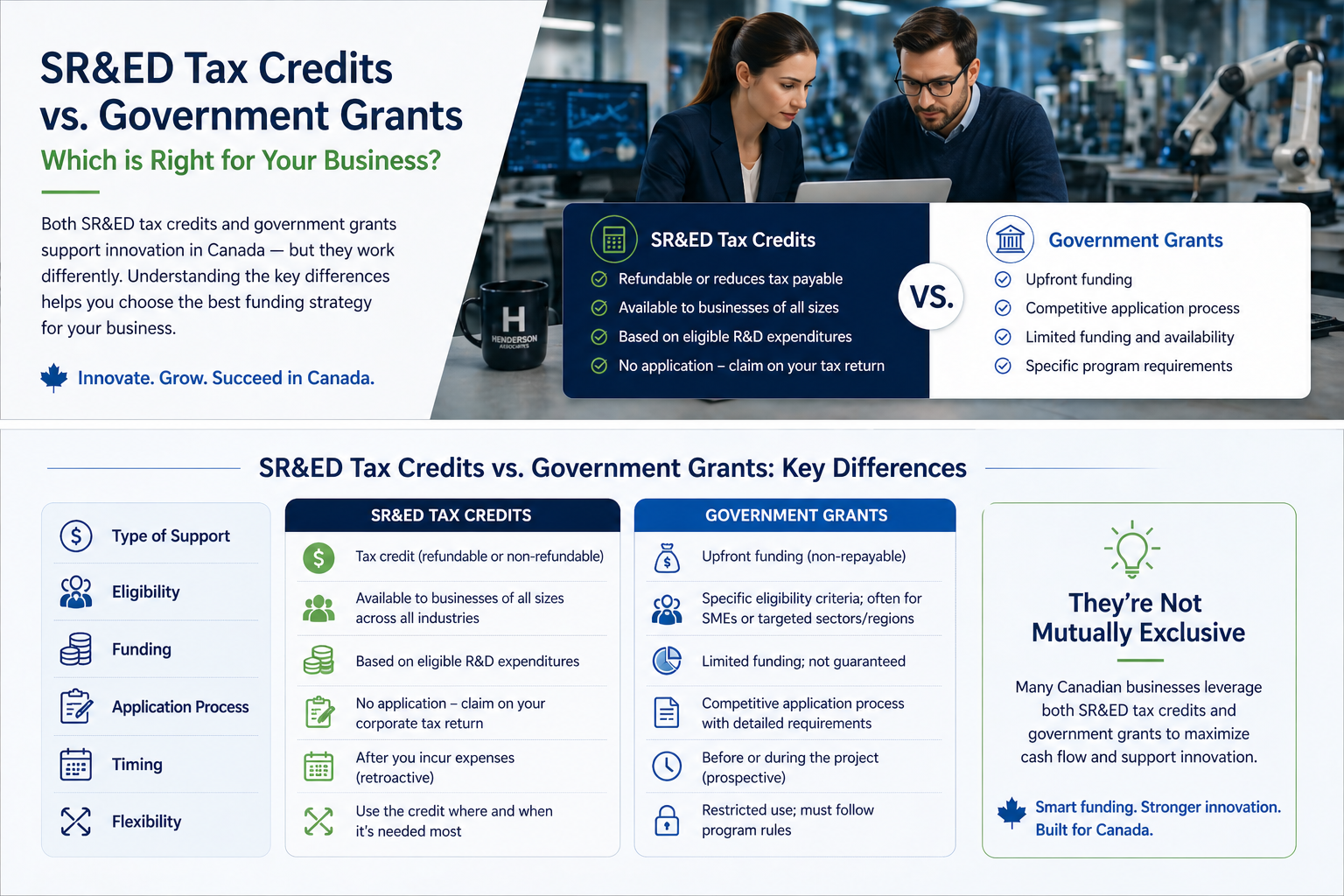
- SR&ED is a tax credit you claim after doing eligible R&D work
- Government grants are upfront funding programs with specific application requirements
Financially, SR&ED often delivers 15% to 35% of eligible development costs, while grants can cover 30% to 70% of specific project budgets—but are far more competitive and restrictive.
For example, a company spending $400,000 on product development might receive:
- $60,000–$140,000+ via SR&ED, and
- $100,000–$200,000 via a grant (if approved)
The real opportunity isn’t choosing one—it’s knowing how to use both strategically.

Key Differences
1. Timing: Retroactive vs Upfront
- SR&ED: Claimed after the work is completed and filed with the Canada Revenue Agency (CRA)
- Grants: Applied for before or during the project
👉 This alone changes how you plan cash flow.
2. Eligibility Criteria
- SR&ED eligibility Canada
- Focuses on technological uncertainty SR&ED
- Requires experimentation and advancement
- Industry-agnostic
- Government grants
- Based on program-specific goals
- May target:
- hiring
- exports
- clean tech
- regional growth
👉 Grants care about economic outcomes.
👉 SR&ED cares about technical uncertainty.
3. Approval Risk
- SR&ED
- Not competitive
- Based on whether your work meets CRA SR&ED criteria
- Predictable if documented properly
- Grants
- Competitive
- Limited funding pools
- Approval is uncertain
4. Funding Structure
- SR&ED
- Tax credit (refund or reduction in taxes)
- Based on actual work performed
- Grants
- Direct funding (non-repayable or partially repayable)
- Often milestone-based
5. Flexibility
- SR&ED
- Broad applicability across industries
- Covers ongoing development work
- Grants
- Narrow scope
- Strict rules on spending and timelines
👉 For a deeper breakdown of SR&ED itself, see our SR&ED guide.
When to Use Each
Use SR&ED When:
- You’re already building or improving technology
- You’re solving non-obvious technical problems
- You want predictable, recurring funding
SR&ED is often the foundation layer of funding.
Use Grants When:
- You’re launching a specific initiative (hiring, expansion, export)
- You can align with a program objective
- You’re willing to go through an application process
Strategic Insight
The strongest funding strategies don’t treat this as “either/or.”
They use:
- Grants → to fund planned initiatives upfront
- SR&ED → to recover costs from technical work already done
This layered approach significantly increases total funding.
For more on structuring this, see our funding strategy blog.
Can You Combine Them?
Yes—and you should.
But there’s an important nuance:
👉 You cannot double-claim the same costs.
If a grant covers part of a salary or project cost:
- That portion reduces your SR&ED claim base
Example
- Total project cost: $500,000
- Grant received: $150,000
- Remaining eligible SR&ED base: $350,000
If eligible:
- SR&ED (15–35%) → $52,500 to $122,500
Why This Matters
Many companies assume grants reduce SR&ED value too much.
In reality:
- You still benefit from both funding sources
- Combined recovery is often higher than using either alone
Examples
Example 1: SaaS Company Scaling Infrastructure
- Applied for a hiring grant to expand dev team
- Performed SR&ED-eligible work on system scalability
Outcome:
- Grant covered hiring costs
- SR&ED recovered experimentation costs
Example 2: Manufacturer Expanding Production
- Received grant for equipment investment
- Conducted SR&ED work on process optimization
Outcome:
- Grant reduced capital burden
- SR&ED covered technical trials
Example 3: AI Startup
- Applied for innovation grant
- Conducted model optimization experiments
Outcome:
- Grant funded project
- SR&ED captured technical uncertainty work
👉 Real-world structuring like this is where most businesses either maximize funding—or leave significant money on the table.
Explore how this applies to your situation on our grants advisory page.
What Most Businesses Get Wrong
- Treating SR&ED and grants as interchangeable
- Not adjusting SR&ED claims after grant funding
- Missing SR&ED entirely after receiving grants
- Failing to align technical work with eligibility criteria
From our experience across industries, the biggest missed opportunity is lack of coordination between funding programs.
FAQ
What is the difference between SR&ED and government grants in Canada?
SR&ED is a tax credit for R&D work, while grants are upfront funding programs with specific objectives.
Is SR&ED better than grants?
Neither is “better”—they serve different purposes. The best approach is using both together.
Can you claim SR&ED if you receive a grant?
Yes, but you must reduce eligible SR&ED expenditures by the grant amount.
Which is easier to get?
SR&ED is generally more predictable; grants are competitive and less certain.
Do all businesses qualify for both?
Not necessarily. SR&ED depends on technical work, while grants depend on program fit.
Next Step
Most businesses don’t have a funding problem—they have a strategy problem.
We regularly see companies:
- Using SR&ED but missing available grants
- Winning grants but failing to claim SR&ED
- Structuring funding inefficiently
A coordinated approach can significantly increase total funding while reducing risk.
Get a funding strategy review to see how SR&ED and grants can work together for your business—before you commit to your next project.