
In this article:
- Opening Answer
- Scientific or Technological Uncertainty
- Experimental Development
- Routine Work vs SR&ED
- Real Examples of What Counts as R&D
- What Most Businesses Misunderstand
- FAQ
- Next Step
Opening Answer
For SR&ED in Canada, R&D is not defined by industry or innovation—it’s defined by uncertainty.
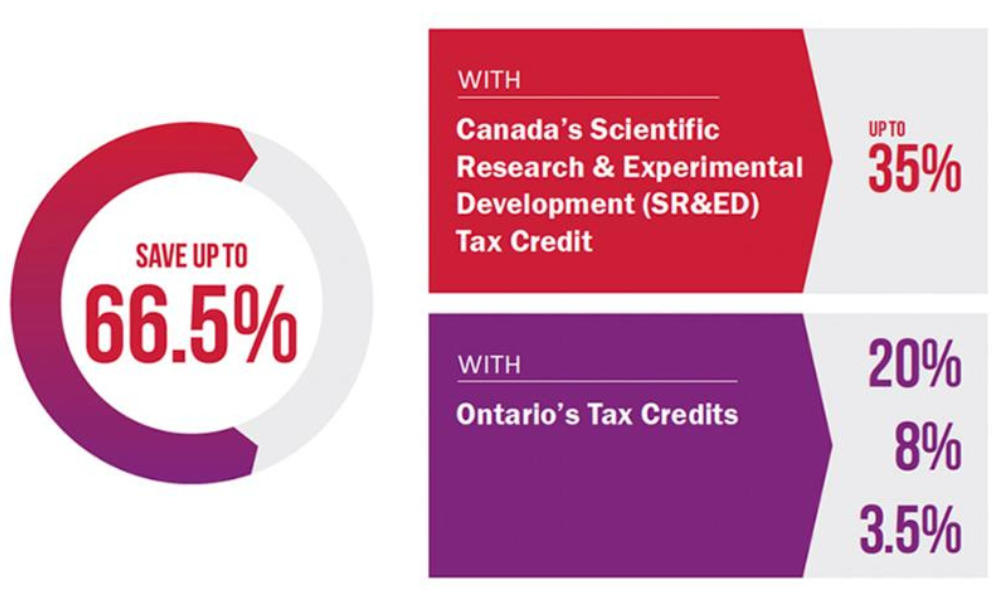
If your team is trying to solve a technical problem where the solution isn’t obvious, and you’re experimenting to figure it out, that work may qualify. Businesses that properly identify this often recover 15% to 35% of eligible costs, turning everyday development into $20,000 to $100,000+ in annual funding.
For example, a company spending $150,000 trying to resolve unpredictable system failures—where standard fixes didn’t work—could recover $22,500 to $52,500+, even if the final solution wasn’t perfect.
The Canada Revenue Agency (CRA) defines eligible R&D based on technological uncertainty, advancement, and systematic investigation—not whether something is “new to your business.”
Scientific or Technological Uncertainty
This is the single most important concept in SR&ED.
What It Means
You are facing a problem where:
- The solution is not known or obvious
- Existing knowledge or standard practices don’t resolve it
- Skilled professionals cannot predict the outcome upfront
What It Looks Like in Practice
- A system fails under load, and no known architecture solves it
- A manufacturing process produces inconsistent results with no clear cause
- A model stops improving despite standard optimization
👉 This is what CRA calls technological uncertainty SR&ED.
What It Is NOT
- “We didn’t know how long it would take”
- “We weren’t sure if users would like it”
- “We needed to build something new”
Those are business or project uncertainties, not technical ones.
👉 Use our SR&ED eligibility checklist to validate your projects quickly.
Experimental Development
Most SR&ED claims fall under experimental development.
This is where your team:
- Tries to resolve technological uncertainty
- Runs tests, iterations, and analysis
- Learns something new about the system or process
What CRA Expects
A valid SR&ED project typically includes:
- Hypothesis (“We believe this architecture may solve the latency issue”)
- Testing (Implementing and evaluating different approaches)
- Analysis (Comparing results, identifying failures)
- Iteration (Refining based on findings)
Key Insight
You don’t need to succeed—you need to learn through systematic experimentation.
This is where many business owners get it wrong. They assume R&D means breakthroughs.
In reality, SR&ED often rewards failed attempts that generate technical insight.
Routine Work vs SR&ED
This is the biggest source of confusion.
Routine Work (Not Eligible)
- Standard feature development
- UI/UX improvements
- Bug fixes with known solutions
- System integrations using established methods
- Regular production or quality control
SR&ED Work (Eligible)
- Solving problems with no clear solution path
- Testing multiple approaches due to uncertainty
- Generating new technical understanding
- Encountering failures that require iteration
Side-by-Side Example
| Scenario | Eligible? | Why |
|---|---|---|
| Adding a login feature | ❌ | Standard implementation |
| Fixing a known bug | ❌ | Solution is obvious |
| Resolving unpredictable system crashes under load | ✅ | Unknown cause + experimentation |
| Improving UI layout | ❌ | No technical uncertainty |
| Designing new architecture to handle scaling failures | ✅ | Requires testing unknown solutions |
👉 For more real-world breakdowns, see our SR&ED examples article.
Real Examples of What Counts as R&D
These are the types of projects that often qualify:
1. Software Scaling Problem
A SaaS company couldn’t maintain performance under high concurrency.
- Standard scaling methods failed
- Engineers tested multiple architectures
- Results were inconsistent
👉 Qualifies due to system-level uncertainty.
2. Manufacturing Process Failure
A company experienced inconsistent output quality.
- Root cause was unclear
- Engineers ran controlled trials
- Multiple variables were tested
👉 This is experimental development, not routine production.
3. AI Model Plateau
A machine learning model stopped improving.
- Standard tuning didn’t work
- New approaches were tested
- Results were unpredictable
👉 This reflects unresolved technical limitations.
4. Integration Challenge
Two systems failed to communicate reliably under real conditions.
- Standard integration methods didn’t work
- Engineers tested multiple configurations
- Failure modes were not predictable
👉 This goes beyond routine integration.
What Most Businesses Misunderstand
From our experience across industries, the biggest issue is this:
Companies assume R&D means “innovation” when it actually means resolving uncertainty.
This leads to:
- Under-claiming valid work
- Misclassifying eligible projects
- Missing funding opportunities
FAQ
What counts as R&D in Canada for SR&ED?
Work that involves technological uncertainty, aims for advancement, and follows a systematic experimental process.
Does routine development count as R&D?
No—unless it involves uncertainty that cannot be resolved using standard methods.
Do failed projects count as R&D?
Yes. Failure can strengthen eligibility if it demonstrates experimentation.
Is R&D only for labs or scientists?
No. Software, manufacturing, and engineering work often qualify.
How do I know if my work counts?
Use a structured framework like an SR&ED eligibility checklist or get a professional assessment.
Next Step
Most businesses don’t miss SR&ED because they lack R&D—they miss it because they don’t recognize what counts.
We regularly identify:
- Projects dismissed as “routine” that actually qualify
- Partial work hidden inside day-to-day development
- Technical uncertainty that was never documented
A focused review can quickly show what you’re eligible to claim.
Get an SR&ED eligibility assessment and find out what your work is really worth—before another claim year is lost.